
Calgary Real Estate: 2026 Affordability Insights
Calgary Real Estate, Affordable Housing, 2026 Market Forecast
Is Calgary Real Estate Still Affordable in 2026?
Wondering if Calgary is still one of Canada’s “last affordable” big-city housing markets in 2026? Let’s walk through the numbers, trends, and real‑world buying scenarios so you can decide if Calgary real estate still fits your budget this year.
Short answer: Calgary is still relatively affordable, but not “cheap” anymore
Compared with Toronto, Vancouver, or even many mid‑sized Ontario markets, Calgary real estate in 2026 is still more affordable—especially when you factor in local incomes and no provincial sales tax. But if you’re expecting 2020‑level prices, you’ll be disappointed. Prices have climbed, borrowing costs are higher, and “affordable” now looks different depending on what you’re buying and where.
Recent data from local MLS® market reports shows:
Average sold price (all property types) around $660,000 for sales between April 8 and May 6, 2026, with a median of about $595,000 for Calgary proper (Zolo, 2026).
City‑wide benchmark price near $568,800 in April 2026, up modestly from earlier in the year (CREB data summarized via CalgaryRealEstateHomes.ca).
So is Calgary real estate still affordable in 2026? Yes, in a Canadian context—especially for buyers relocating from higher‑priced provinces. But for many local first‑time buyers and renters, affordability is under real pressure, which is why the City’s “Home is Here” housing strategy and federal Housing Accelerator Fund investments matter so much right now.
📌 Featured snippet‑style takeaway: Calgary remains more affordable than Toronto or Vancouver in 2026, with a benchmark price around $569K and median prices near $595K, but rising mortgage rates and tight supply mean affordability depends heavily on property type, neighborhood, and income.
Calgary market trends 2026: What’s actually happening on the ground?
To understand affordability, you first need a clear view of Calgary market trends in 2026. The big picture: the city has shifted from a red‑hot seller’s market to something closer to balance, but the story changes a lot depending on whether you’re looking at detached homes, townhouses, or condos.
From overheated to almost balanced
According to 2026 market updates, Calgary moved from a prolonged seller’s market into a more balanced environment as supply improved and migration cooled slightly. February 2026 benchmark prices were around $560,500, about 4.4% below the previous year, with a modest rebound into spring at roughly $568,800 by April (Ovlix; CalgaryRealEstateHomes.ca).
Why this matters: A balanced market usually means fewer bidding wars, more choice, and slightly better negotiating power for buyers—especially outside the most in‑demand neighborhoods.
Detached vs. condos: A split personality market
The 2026 Calgary real estate market is really a segment story:
Detached homes in established West and Southwest communities remain resilient, with just under 3 months of supply—borderline seller’s territory. February 2026 sales dipped only about 4% year‑over‑year, and prices held up well (CalgaryHomeSelling.ca; LuxuryHomesCalgary.ca).
Semi‑detached properties are even tighter, with roughly 2.4 months of supply and monthly price gains in early 2026, signaling strong demand for “missing middle” housing.
Apartments/condos are where buyers have the most leverage. February 2026 data shows a 27% drop in sales, about 4.6 months of supply, and benchmark prices down roughly 9% year‑over‑year to around $298,600 (LuxuryHomesCalgary.ca).
Row and townhomes sit in between—benchmark prices down about 5–6% year‑over‑year (around $423,600 in February 2026) with just over 3 months of supply, pointing to a more balanced but slightly soft segment (CalgaryHomeSelling.ca).
💡 Expert insight: If you’re a value‑driven buyer in 2026, the condo and townhouse segments are where you’re most likely to find negotiable prices, seller incentives, and better selection—especially in new high‑density developments.
Price forecast: Flat to modest gains, depending on rates and the economy
Forecasts from local brokerages and national outlooks, including the Canada Mortgage and Housing Corporation (CMHC), point to a stabilizing market with low single‑digit price changes in 2026:
Base‑case scenarios call for flat to slightly positive price growth, with spring 2026 bringing modest gains, especially for detached homes (FindYourCalgary.ca; CMHC Housing Market Outlook).
Royal LePage projects aggregate home prices in Calgary to rise about 1.5% in Q4 2026 versus Q4 2025, with detached homes staying stable and condos under more pressure.
In other words, no crash, no frenzy—just a more normal, data‑driven market where your individual strategy matters more than trying to time a big swing.
Next step: If you’re actively comparing neighborhoods, pair these city‑wide trends with a local market report or neighborhood‑level stats tool so you can see how inner‑city infills, new suburbs, and downtown condos each behave differently.
Calgary home prices in 2026: What does “affordable” really look like?
“Is Calgary affordable?” quickly turns into “Affordable for whom—and for what type of home?” To answer that, let’s break down the latest numbers by price metric and housing type, then translate them into real‑world monthly payments.
Average vs. median vs. benchmark: Quick definitions
Average price – Total value of all homes sold divided by number of sales. Can be skewed by a few luxury properties.
Median price – The middle price when all sales are lined up from lowest to highest. Less sensitive to extremes and often closer to what a “typical” buyer spends.
Benchmark price – A model‑based estimate of the value of a “typical” home in a given area and segment (used widely by boards like CREB and supported by national bodies like CREA and CMHC).
Why this matters: When you’re comparing Calgary to other cities or tracking trends over time, benchmark and median prices usually give a clearer read on affordability than averages alone.
Calgary home price snapshot: Spring 2026
Metric / Segment Approx. Price (Spring 2026) Source / Notes Average sold price (all types) $660,043 MLS® sales, Apr 8–May 6, 2026 (Zolo) Median price (all types) $517,500 As of May 7, 2026 (Kleibrink Real Estate) Detached median $599,950 May 7, 2026, median, DOM ~19 (Kleibrink) Townhouse median $395,000 May 7, 2026, median, DOM ~38 (Kleibrink) City‑wide benchmark (all types) $568,800 April 2026 benchmark (CREB via CalgaryRealEstateHomes.ca)
Put simply, the typical Calgary home in 2026 costs somewhere in the high‑$500Ks to low‑$600Ks, with condos and townhouses offering lower entry points and detached homes pushing higher, especially in established communities.
What does that mean in monthly payments?
Let’s use rough, illustrative numbers (not financial advice—always check with your lender or a mortgage broker):
$400,000 condo or townhouse, 10% down, 25‑year amortization, 5.25% fixed rate → principal and interest around $2,100–$2,200/month, plus condo fees and taxes.
$600,000 detached home, 10% down, same assumptions → roughly $3,100–$3,300/month for principal and interest, plus property tax and utilities.
Why this matters for affordability: For a median‑income Calgary household, those payments can be manageable, especially with two incomes—but for single buyers or households facing higher non‑housing costs, it’s tight. That’s where secondary suites, co‑buying, and non‑market housing options come into play.
Affordable housing in Calgary 2026: Beyond the resale market
When people talk about Affordable Housing Calgary, they’re often thinking only about resale prices. But for tens of thousands of Calgarians, affordability is really about non‑market housing, rentals, and creative supply programs—areas where the City of Calgary has been unusually aggressive compared with many Canadian municipalities.
The scale of the challenge: 100,000 households in need by 2026
According to the City’s 2023–2026 service plan, more than 81,000 Calgary households currently require affordable housing, a figure expected to rise to roughly 100,000 by 2026 (City of Calgary, Affordable Housing Service Plan). That includes seniors, newcomers, low‑income families, and workers in essential but lower‑paid sectors like retail, hospitality, and care services.
Why this matters: Even if you’re a higher‑income buyer, the health of Calgary’s housing market—and the city’s long‑term economic growth—depends on whether people at all income levels can live reasonably close to where they work.
“Home is Here”: Calgary’s 2024–2030 housing strategy
Calgary’s “Home is Here” Housing Strategy (2024–2030) lays out 98 actions to tackle supply, equity, and Indigenous housing needs. Highlights include:
17 city‑owned sites sold below market value, enabling about 835 new homes.
Over 3,500 non‑market homes created since 2017 through partnerships and capital funding (City of Calgary housing infrastructure assessment).
New property tax exemptions for non‑profit non‑market housing providers and Indigenous‑led initiatives such as “For Indigenous, By Indigenous” projects.
By early 2025, the city reported that 88% of the strategy’s actions had been initiated or planned, with permits approved for more than 22,500 market homes and 893 non‑market homes in 2024 alone (City of Calgary 2025 progress report).
2026 affordable housing programs shaping the market
Housing Capital Initiative (HCI): Roughly $60 million invested over two rounds, including $29.3 million in 2026 alone, to support around 566 new non‑market homes (Calgary CityNews, 2026).
Downtown office‑to‑housing conversions: About 100,000 sq. ft. of vacant office space being converted into 128 non‑market homes, backed by $10.3 million from the federal Housing Accelerator Fund (HAF) and delivered by non‑profits like HomeSpace Society and Trellis Society (City of Calgary newsroom, 2026).
Backyard Suite Incentive Program: Up to $15,000 toward construction plus up to 40% of underground infrastructure costs (max $20,000) to encourage homeowners to build secondary suites, funded by about $10 million from the HAF (Calgary CityNews, 2026).
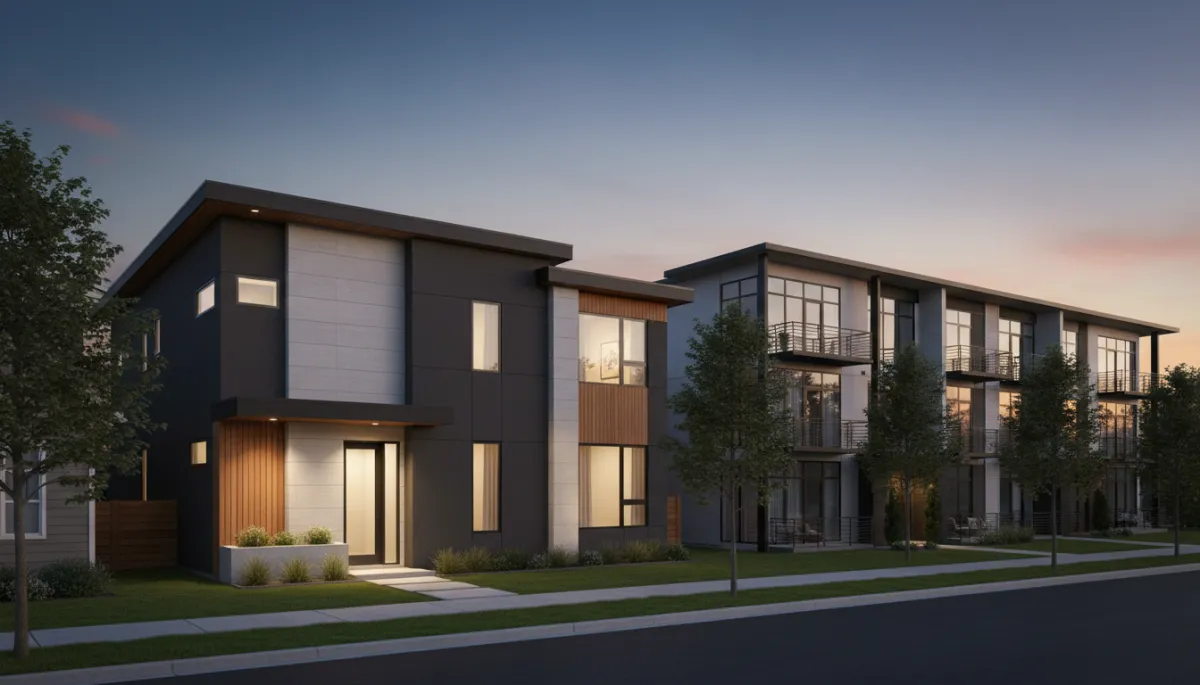
Street-level view of a modern Calgary infill home with secondary suite entrance and nearby...
Secondary suites and new mid‑rise projects are key tools in Calgary’s 2026 affordability strategy.
Key insight: Calgary isn’t just adding suburban subdivisions; it’s aggressively using incentives, conversions, and non‑profit partnerships to expand both market and non‑market housing. That helps keep overall price growth in check, even as demand remains strong.
Buying property in Calgary in 2026: Who still finds it affordable?
Now let’s get practical. If you’re thinking about buying property in Calgary in 2026, how realistic is it—especially if you’re a first‑time buyer, a move‑up family, or someone relocating from another province?
Scenario 1: Local first‑time buyer
Imagine a couple earning a combined $120,000–$140,000 per year. With today’s stress test and mortgage rates, they might qualify for something in the $450,000–$550,000 range, depending on debts and down payment savings. In 2026 Calgary, that can still buy:
A newer two‑bedroom condo in many neighborhoods, or
A townhouse in an outer suburb, possibly with a small yard or garage.
A detached home in a prime inner‑city community is harder at that price point, but not impossible in emerging or farther‑out areas—especially if you’re open to older homes or properties with a legal secondary suite to offset costs.
Scenario 2: Relocating from Toronto, Vancouver, or the GTA
For buyers coming from Ontario or B.C., Calgary in 2026 often feels like a reset button. Selling a townhome or small detached in the GTA for $900K–$1.1M and buying in Calgary for $650K–$750K can mean:
A larger, newer detached home with a yard and attached garage, or
A well‑located inner‑city infill closer to downtown jobs and amenities.
That arbitrage—combined with no provincial sales tax and comparatively strong local incomes in energy, tech, logistics, and professional services—is a big reason Calgary remains a magnet for inter‑provincial migration, according to Statistics Canada and CMHC’s market commentary.
Scenario 3: Investor or house‑hacker
For investors or “house‑hackers” (owner‑occupiers who rent out part of their property), Calgary’s 2026 market offers:
Relatively lower entry prices than other major metros.
Strong rental demand, particularly for well‑located condos, townhomes, and homes with legal suites.
A city government actively incentivizing secondary suites and gentle density, which can improve cash‑flow potential.
Common mistake to avoid: Assuming Calgary’s affordability means you can skip the numbers. In 2026, interest rates and operating costs can still make or break your deal. Always stress‑test your mortgage and factor in condo fees, utilities, and vacancy risk.
Pros and cons of Calgary real estate affordability in 2026
Pros (Affordability Drivers) Cons (Affordability Pressures) Lower prices than Toronto/Vancouver for similar homes and incomes. Higher mortgage rates vs. early‑2020s; stress test still strict. Balanced market conditions reduce bidding wars in many segments. Detached homes in prime areas remain expensive and competitive. Oversupply in condos/townhomes offers negotiation room and options. Non‑market housing demand far exceeds supply; long waitlists. Strong city‑led supply initiatives (HAF, office conversions, suites). Rapid population growth keeps upward pressure on rents and prices. No provincial sales tax and relatively strong local wage base. Income inequality means affordability is uneven across households.
Bottom line: Calgary in 2026 is still one of Canada’s more accessible major housing markets, but it’s no longer “undervalued.” Affordability now hinges on smart product choices (condo vs. detached), location trade‑offs, and careful financing.
2026 real estate forecast: Will Calgary become more or less affordable?
Looking through the rest of 2026, most credible forecasts—from CMHC, major brokerages, and local boards—point to a “soft landing” rather than a boom or bust. The key forces to watch are:
Interest rates: If the Bank of Canada eases borrowing costs, detached prices could see low single‑digit gains, while condos and townhomes stabilize or tick up slightly. If rates stay higher for longer, oversupplied segments may see further small declines.
Migration and employment: Continued in‑migration from other provinces and strong employment in energy, tech, and logistics support demand—but any major economic slowdown would cool prices and rents.
Supply pipeline: With roughly 26,000 units under construction in 2025 (many of them apartments), new completions in 2026 will keep a lid on condo and townhouse prices, even if detached stays tight (Ovlix; CMHC).
Featured answer: Most 2026 forecasts call for flat to low single‑digit price growth in Calgary, with detached homes slightly outperforming and condos/townhomes lagging. That suggests affordability will neither dramatically improve nor collapse—it will evolve slowly and unevenly by segment.
Common mistakes buyers make in Calgary’s 2026 market (and how to avoid them)
Chasing last year’s deals: Waiting for 2020‑style prices to come back can mean missing today’s realistic opportunities in condos and townhomes, where values are already adjusted and negotiable.
Ignoring carrying costs: Focusing only on purchase price, not on monthly payments, condo fees, utilities, and maintenance—especially on older detached homes that may need upgrades to meet energy and safety codes.
Under‑researching neighborhoods: Calgary’s communities differ dramatically in transit access, school catchments, future development plans, and flood or climate risk—all of which affect long‑term value and livability.
Skipping pre‑approval: In competitive detached and semi‑detached segments, not having firm financing can mean losing out on well‑priced homes.
Smart move: Treat your 2026 Calgary purchase like a 10‑year decision, not a one‑year flip. Focus on location quality, housing type that fits your lifestyle, and a payment you can live with through different interest‑rate cycles.
FAQs: Calgary real estate affordability in 2026
1. Is Calgary still cheaper than other major Canadian cities in 2026?
Yes. Calgary’s benchmark and median prices remain significantly lower than Toronto and Vancouver, even after recent gains. Combined with strong local wages and no provincial sales tax, that keeps Calgary relatively affordable, especially for inter‑provincial movers.
2. What is the average home price in Calgary in 2026?
Recent MLS® data for April–May 2026 shows an average sold price around $660,000, a median around $517,500–$595,000 depending on the data cut, and a benchmark price near $568,800 (Zolo; CREB market reports).
3. Are condo prices in Calgary going up or down in 2026?
Condo and apartment prices are under downward or flat pressure in early 2026, with some segments down around 9% year‑over‑year and higher months of supply. That creates opportunities for buyers but also means you should think longer term about appreciation.
4. Is 2026 a good year to buy a house in Calgary?
If your job and finances are stable, 2026 can be a solid entry point. The market is more balanced than in the pandemic years, prices are not spiking, and there’s real choice in condos and townhomes. Detached homes are still competitive but not at peak‑frenzy levels.
5. How much income do I need to buy a home in Calgary in 2026?
It depends on your debts and down payment, but many lenders suggest that a couple earning $120,000–$150,000 annually, with modest debts and a 10–20% down payment, could qualify in the $500,000–$650,000 range. Always confirm with a mortgage professional and consider Bank of Canada guidance on debt‑service ratios.
6. What is the most affordable type of housing in Calgary right now?
Condos and townhomes are generally the most affordable ownership options in 2026, with median townhouse prices around $395,000 and condo benchmarks under $300,000 in some segments. For renters or households in core need, non‑market housing and secondary suites offer additional options, though supply is limited.
7. How is the City of Calgary improving housing affordability?
Through its “Home is Here” strategy, the City is investing tens of millions into non‑market housing, converting vacant offices into homes, incentivizing backyard suites, and selling city land below market to non‑profit providers. It also exceeded its federal Housing Accelerator Fund targets early, delivering more than 44,000 units by mid‑2025.
8. Are rents in Calgary affordable in 2026?
Rents have risen sharply in recent years due to population growth and limited purpose‑built rental stock. While Calgary rents are still often lower than in Vancouver or Toronto, many households now spend a high share of income on housing, which is why the City projects up to 100,000 households in need of affordable housing by 2026.
9. Will Calgary home prices drop in 2026?
Most forecasts from CMHC, local boards, and national brokerages do not predict a major drop. Instead, they call for flat to low single‑digit changes, with some softness in oversupplied condo segments and more stability in detached homes. A deeper correction would likely require a combination of high rates and a local economic downturn.
10. Is it better to rent or buy in Calgary in 2026?
If you plan to stay for five years or more, have stable income, and can handle maintenance and taxes, buying can still make sense—especially in entry‑level segments where rents are high. If your job or life plans are uncertain, or you lack a down payment, renting (including in a secondary suite) can preserve flexibility while you watch the market.
11. Are there grants or incentives for buyers in Calgary?
While most 2026 incentives are aimed at builders and homeowners adding units (like the Backyard Suite Incentive Program), buyers may still access federal programs such as the First‑Time Home Buyer Incentive or RRSP Home Buyers’ Plan. Check current CMHC and Government of Canada resources for up‑to‑date eligibility.
12. How long do homes stay on the market in Calgary in 2026?
Detached homes are selling relatively quickly, with median days on market around 19 days in early May 2026, while townhomes take longer at about 38 days. Condos vary widely depending on building, price point, and location.
Conclusion: Is Calgary real estate still affordable in 2026?
Calgary in 2026 sits in a middle zone: no longer the hidden bargain it once was, but still far more accessible than many other Canadian metros. Detached homes in prime neighborhoods are stretching local budgets, yet condos, townhomes, and emerging communities offer realistic pathways to ownership for middle‑income households—especially those willing to be flexible on location and housing type.
For renters and households in core housing need, the affordability picture is tougher. But the scale of Calgary’s response—through the “Home is Here” strategy, Housing Accelerator Fund projects, office‑to‑residential conversions, and backyard suite incentives—puts the city among the more proactive jurisdictions in Canada, according to CMHC and municipal reports.
In one line: Calgary real estate is still affordable by Canadian big‑city standards in 2026, but affordability now depends on making smart choices about property type, neighborhood, and financing—not on expecting “cheap” prices.
Your next steps: How to move from research to action
If you’re serious about exploring Calgary real estate in 2026, here’s a simple roadmap to follow:
Clarify your time horizon. Are you planning to stay in Calgary for 3, 5, or 10+ years? Your answer shapes whether buying or renting makes more sense.
Get pre‑approved. Talk to a mortgage professional who understands local conditions, CMHC guidelines, and Bank of Canada stress‑test rules so you know your real budget before shopping.
Decide on housing type. Detached, semi‑detached, townhouse, or condo? Each has its own affordability profile, maintenance obligations, and long‑term appreciation patterns in Calgary.
Compare neighborhoods. Look at commute times, schools, transit, amenities, and future development plans. A slightly longer drive can sometimes save you six figures on purchase price.
Run the full budget. Go beyond the mortgage: include taxes, utilities, condo fees, insurance, and a repair reserve. Use a detailed housing cost calculator to stress‑test different scenarios.
Whether you’re just starting to watch Calgary market trends or you’re ready to start buying property in Calgary this year, the key is to ground your decisions in today’s data—not last decade’s narratives. With the right strategy, Calgary in 2026 can still offer a realistic path to homeownership and long‑term stability.
Recommended schema, snippets, and social caption
For technical implementation, this article is well‑suited to Article or BlogPosting schema with additional FAQPage markup for the question‑and‑answer section. Marking up key stats (benchmark price, median price, and forecasts) as structured data can improve visibility in rich results and AI overviews.
Featured snippet opportunity: Use a concise definition block such as “Calgary remains more affordable than Toronto and Vancouver in 2026, with a benchmark price around $569K and median prices near $595K, but affordability depends on property type, neighborhood, and income.”
Sample social media caption: “Is Calgary still one of Canada’s last affordable big‑city markets in 2026? 🏙️ We break down real prices, market trends, and what buyers can actually afford—from condos under $400K to detached homes near $600K. Before you make a move, see where Calgary really stands this year.”


